Voucher Checks Explained: When You Need Them
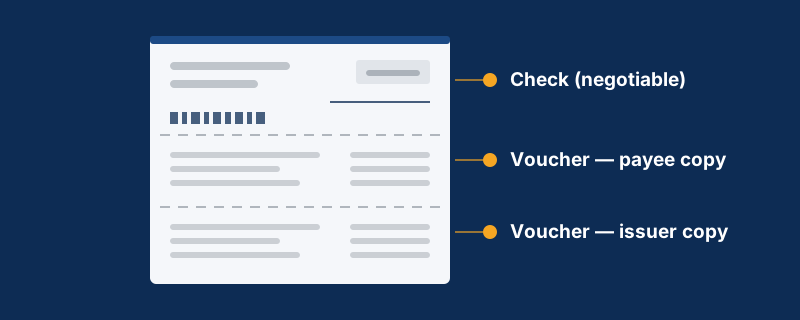
A voucher check is a check printed on a single perforated sheet with detachable stubs — typically one check at the top and two vouchers below it. The stubs are not negotiable; they carry the payment detail. One goes to the payee so they can match the payment to the right invoice or read their payroll deductions, and one stays with the issuer as the accounts payable record. You need voucher checks when the payment has to explain itself: payroll, and vendor payments that settle specific invoices. For a personal check to the plumber, standard check stock is fine and cheaper.
What Is a Voucher Check?
A voucher check gets its name from the voucher — the stub — attached to it. The sheet is printed with perforated separation lines: the top portion is the negotiable check, and the sections below it are non-negotiable records of what the payment is for. The payee detaches the stub and keeps it to reconcile the payment in their accounts receivable; the payer retains a copy for accounts payable and audit documentation.
That is the entire point of the format. A standard check tells the bank how much to move. A voucher check additionally tells both parties why, and it does it on paper that travels with the payment instead of in a separate email that arrives at a different time.
The Format: One Check, Two Stubs
The common business layout is a single letter-size perforated sheet carrying one check and two stubs. Suppliers describe it as check-on-top, and it is the layout QuickBooks and most accounting software expect when you select the voucher check style. Voucher stock is also sold check-in-middle and check-on-bottom, so the position is a specification you have to match to your software, not a detail you can assume. This letter-size, stub-carrying format is one of the main things that separates business check paper from personal check paper.
What lands on the stubs depends on the payment:
- Payroll. The voucher becomes the pay stub — gross wages, federal and state withholding, Social Security and Medicare contributions, benefit deductions, and net pay.
- Accounts payable. The voucher lists invoice numbers, dates, amounts, discounts taken, and adjustments, so the payee can post the payment to the right open invoices without guessing.
Because the sheet is one check per page rather than three, voucher stock costs more per check than a three-per-page format. That is the trade you are making: paper for documentation. Our guide to buying cheap check paper online covers when that trade is worth making and when it isn't.
When You Actually Need Them
Voucher checks earn their extra cost in three situations:
- You run payroll on paper. Employees need the deduction breakdown, and the voucher is where it goes. This is the clearest case for the format.
- You pay vendors against invoices. A payment that settles several invoices at once is ambiguous without remittance detail. The stub removes the ambiguity and the follow-up email chain that comes with it.
- You need an audit trail on paper. The retained stub links each disbursement to the documents it settles — useful when someone later has to reconstruct why a check was written.
Conversely, you do not need them for personal checks, one-off payments with no invoice behind them, or any payment where your accounting software already emails a remittance advice. It is worth being honest that voucher checks are a paper solution to a problem electronic payments largely solved: for high-volume transactions, EDI remittance formats have replaced them, and the businesses still relying on voucher checks tend to be the ones without that electronic infrastructure in place.
Voucher vs. Standard Check Stock
| Voucher check stock | Standard / 3-per-page stock | |
|---|---|---|
| Checks per sheet | One, with two stubs below | Three, no stubs |
| Cost per check | Higher — a full sheet per payment | Lower |
| Carries payment detail | Yes — invoice or payroll breakdown | No |
| Typical use | Payroll, vendor payments, accounts payable | General disbursements, personal checks |
| Software support | Selected as a distinct “voucher” check style | Default check style |
What to Check Before You Buy
- Check position. Top, middle, or bottom must match what your software prints. If you use QuickBooks, our guide to QuickBooks-compatible check paper covers how the check styles map to stock.
- Blank vs. pre-printed. Blank voucher stock needs a MICR-capable printer, since your printer lays down the bank data and the magnetic line — see MICR check paper explained. Pre-printed voucher checks arrive with your bank details already on them.
- Security features. The stubs are not the security story; the paper is. Voucher stock is sold across the same security tiers as any other check paper — our guide to check paper security features explains which ones matter.
- Printer compatibility. Confirm the stock is rated for laser or inkjet, whichever you own. Our roundup of where to buy check paper online lists suppliers that publish the full specification.
Frequently Asked Questions
What is a voucher check?
A check printed on a perforated sheet with detachable stubs — usually one check and two vouchers. The check is negotiable; the vouchers are records of what the payment covers. One is for the payee, one for the issuer.
Is a voucher check the same as a pay stub?
The voucher becomes the pay stub when the check is a paycheck. In payroll use, the stub itemises gross pay, tax withholding, deductions, and net pay. In accounts payable use, the same physical stub carries invoice detail instead.
Can I print voucher checks on ordinary check paper?
No — the perforations are part of the stock. A standard three-per-page sheet has no stub to detach, and printing voucher data onto it would leave the payment detail attached to a negotiable check.
Do voucher checks cost more?
Per check, yes: one sheet produces one check instead of three. Whether that is worth it depends on whether the payment needs to explain itself. For payroll and invoice settlement, it usually is.