Business vs. Personal Check Paper: What's the Difference?
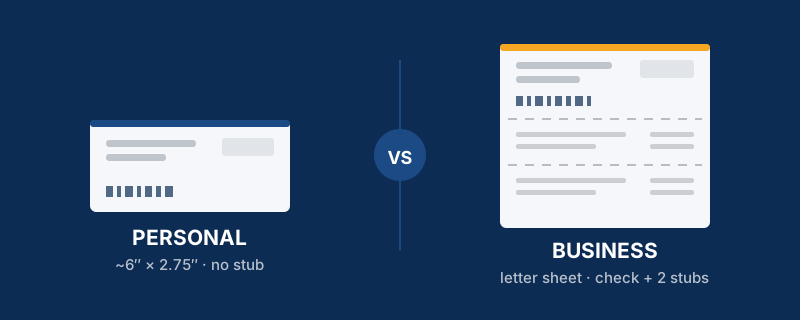
The core difference is size and what fills it. A personal check is small — about 6″ by 2.75″ — and comes in a wallet checkbook with no stub. A business check is printed on a full letter-size sheet, with the check itself around 8.5″ by 3.5″ and one or two voucher stubs filling the rest of the page. That extra room is the whole point: business check paper carries invoice detail, accounts-payable coding, sometimes a second signature line, and it is built to feed a laser printer and line up with accounting software. If you pay vendors or run payroll, you want business check stock. For household bills, personal checks are fine and cheaper.
Size and Format
A personal check measures roughly 6″ wide by 2.75″ tall and ships in a wire-bound checkbook of 25 to 50 checks. There is one layout: the wallet check, with no stub.
Business check paper is a different object. It prints on a full 8.5″ by 11″ sheet, the check occupying about 8.5″ by 3.5″ of it, and the remaining space carrying the voucher stubs. Because the sheet is standard letter size, it feeds an office laser or inkjet printer and files flat in a binder or an accounts-payable archive. Business stock also comes in several layouts, which is why you have to match the position to your software rather than assume it:
- Check-on-top with two voucher stubs below — the common QuickBooks layout.
- Check-in-middle — the format Sage 50 / Peachtree expect.
- Check-on-bottom with two stubs above.
- Three-per-page with no stubs, for issuing several checks efficiently.
- Manual / handwritten with carbonless duplicates, for a desk register.
- Blank stock for in-house MICR printing.
The check-on-top format is the one most people mean by “voucher check.” Our guide to voucher checks covers who keeps each stub and when the format earns its cost.
What Each Check Carries
A personal check shows an individual's name, home address, and personal account details. A business check shows the legal business name, business address, and often a company logo — and, on the stub, the payment detail that a personal check has nowhere to put: invoice numbers, AP coding fields, and, for payroll, the deduction breakdown. When dual authorization is required, business stock can carry a second signature line, which a wallet check has no room for.
This is also a bookkeeping distinction, not just a stationery one. Paying business expenses from a personal account mixes — “commingles” — personal and business funds. For an LLC, S-corp, or partnership, that mixing on its own rarely pierces the corporate veil, but combined with other lapses it can expose personal assets, and mixed records make tax deductions harder to substantiate and more likely to draw IRS attention. The separate paper trail a business check creates is part of why the format exists.
Security Differences
Personal checks carry basic security. Business check paper is where the enhanced features cluster — chemically reactive paper that stains visibly if someone tries to wash or alter the check, microprinting, watermarks, thermochromic ink, void pantographs, and fluorescent fibers. That is not because businesses are inherently bigger targets by rule, but because business payments travel by mail, settle larger amounts, and pass through more hands, so the stock is sold at higher security tiers by default. Our guide to check paper security features explains what each of those defences actually stops.
Printer and Software Compatibility
Personal checks are written by hand. Business checks are designed to print — to feed a laser or inkjet printer and align precisely with QuickBooks, Quicken, Sage 50, and similar software, so the check lands where the software expects and the MICR line sits in the correct position for the bank's scanners. That MICR line is non-negotiable: whichever format you buy, the magnetic line has to read, which is covered in our guide to MICR check paper. If you are choosing a printer for this, see the best printers for printing checks.
Cost
A box of 150 personal checks ordered through a bank typically runs about $25 to $40. A box of 250 business checks from a direct printer runs roughly $35 to $70 depending on format and security tier. Per check, the gap is modest — and buying blank business stock rather than pre-printed boxes narrows it further. If price is the deciding factor, our guide to cheap check paper online covers which savings are safe and which get checks returned.
Prices reflect the ranges reported by check suppliers at the time of writing and vary by vendor, format, and security tier — confirm current pricing before ordering.
Which Do You Need?
| Personal check paper | Business check paper | |
|---|---|---|
| Size | ~6″ × 2.75″ (wallet) | ~8.5″ × 3.5″ on a letter sheet |
| Stub for records | No | Yes — one or two vouchers |
| Printer-fed | Hand-written | Laser / inkjet, software-aligned |
| Security tier | Basic | Typically enhanced |
| Typical cost | ~$25–$40 / 150 | ~$35–$70 / 250 |
| Best for | Household bills, personal payments | Vendor payments, payroll, bookkeeping |
- Sole proprietor with no separate entity? You may use personal checks, but a dedicated business account and business checks keep your bookkeeping clean from day one.
- Incorporated (LLC, S-corp, partnership)? Use business checks. Paying from a personal account commingles funds and complicates both liability protection and taxes.
- Paying vendors against invoices or running payroll? Business voucher stock, so the remittance detail travels with the payment.
Once you know which you need, our roundup of the best places to buy check paper online compares suppliers that stock both.
Frequently Asked Questions
Can I use personal checks for my business?
A sole proprietor without a separate legal entity can, though it muddies the bookkeeping. If your business is incorporated — an LLC, S-corp, or partnership — paying from a personal account commingles funds, which can weaken liability protection and complicate your taxes. Business checks on a dedicated account keep the trail clean.
Why are business checks bigger than personal checks?
They need the room. A business check carries voucher stubs for invoice numbers, AP coding, or payroll deductions, and sometimes a second signature line — none of which fit on a wallet check. The letter-size sheet also feeds an office printer and files flat.
Is business check paper more secure than personal check paper?
Usually, because it is sold at higher security tiers by default — chemically reactive paper, microprinting, watermarks, void pantographs and more. The features are properties of the stock, so a high-security personal check and a basic business check can swap places; the tier on the listing is what matters, not the label.
Do business and personal checks use different bank processing?
No. Both clear through the same system and rely on the same MICR line at the bottom. The size and stub differences are about record-keeping and printing, not about how the bank reads the check.