Cheap Check Paper Online: How to Save Without Risking Rejection
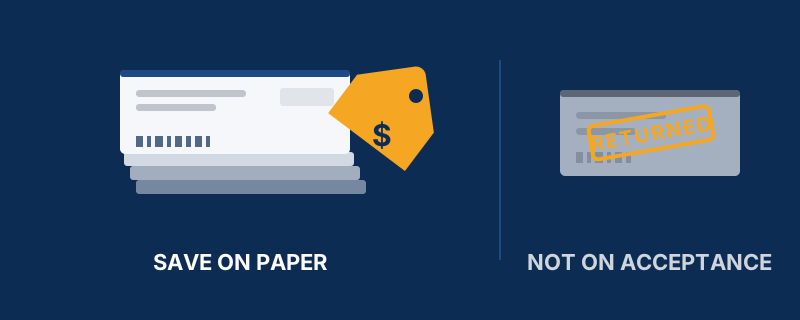
You can buy cheap check paper online safely — but the savings have to come from the right place. Buying in larger quantities, choosing a lower security tier, and skipping premium tamper-proofing are legitimate ways to cut the price. Dropping below standard 24 lb. check stock, or printing the MICR line with ordinary toner to save on supplies, is not: that is where checks start coming back. Suppliers price check paper by security tier, so a ream can range from roughly $43 to $83 for the same sheet count. The cheapest sheet that still gets accepted is the one you want — not the cheapest sheet on the page.
What Actually Drives the Price
Check paper is not one product at one price. Suppliers sell it in tiers, and the tier — not the brand — is what moves the number. TROY, for example, lists blank check paper by the ream, with its basic security paper around $43 and its top tamper-resistant grade around $83 at the time of writing. Same format, same ream, roughly double the price. What you are paying for in the gap is the security layer: watermarks, chemical-sensitive coatings, and the rest of the features covered in our guide to check paper security features.
The other lever is quantity. Suppliers routinely discount by the case rather than the ream, and some publish volume breaks at a few thousand sheets. If you print checks regularly, ordering in a larger block is the single least risky way to lower your cost per check — nothing about the paper changes, only the unit price.
Where You Can Safely Save
- Buy blank stock instead of pre-printed checks. This is the biggest single saving available and it costs you nothing in acceptance, because your printer adds the bank data at print time. Our blank check stock vs. pre-printed checks comparison lays out the numbers.
- Order in case quantities. Same paper, lower unit price, provided you will actually use it. Check stock does not expire, but a box of unused checks is still money sitting idle — and, if it is pre-printed, a fraud risk.
- Match the security tier to your actual exposure. A household writing two checks a month has a different risk profile from a business mailing payroll. Paying for a premium tamper-resistant grade is sensible for the latter and optional for the former.
- Skip pre-printed logos and custom colours. Personalisation is priced as a premium and adds nothing a bank cares about.
- Use a format you can fill completely. Three-per-page stock costs less per check than one-per-page voucher stock — but only if you need the format. Our guide to voucher checks covers when the larger format is actually required.
Where Cheap Becomes a False Economy
Three savings look attractive on the product page and cost you at the bank.
- Under-weight or glossy paper. The industry standard for blank check stock is 24 lb. paper, and that weight and finish is what MICR printing and mobile-deposit imaging are optimised for. Stock that is too thin, too thick, or too glossy produces substandard images that mobile deposit apps reject — and a check your recipient cannot deposit from their phone is a check you will be writing again.
- Ordinary toner instead of MICR toner. Skipping the MICR cartridge is the most common reason a printed check is refused. Standard laser toner has no iron oxide particles, so the bank's sorting machines cannot read the MICR line magnetically and the deposit fails verification. See what MICR check paper is and laser vs. inkjet check paper for the supply side of this.
- Stock with no security features at all. Paper-level defences are what make a check hard to copy or wash after you have posted it. A saving of a few dollars a ream is not worth an altered check, and some banks and payees look for these features.
The Real Cost of a Rejected Check
A rejection is not just an inconvenience. Poor MICR quality — faint or illegible lines, misaligned characters, non-standard fonts — forces the bank to repair the item by hand, and banks may charge corporate customers anywhere from $0.50 to $6.00 per item that needs repairing or that arrives as a poor-quality MICR document, according to MICR printer manufacturer TROY.
Set that against the saving. Even at the top of TROY's own range, the price gap between basic and premium check paper works out to a modest amount per check. A handful of repair charges — or one payroll run a bank sends back — erases it. This is the arithmetic that makes “cheap but accepted” the right target rather than “cheapest available.”
Buying Checklist
| Before you order, confirm… | Why it matters |
|---|---|
| Paper weight is 24 lb. | The standard weight MICR printing and mobile deposit imaging expect. |
| Finish is matte, not glossy | Glossy stock images badly and can smear. |
| Rated for your printer (laser or inkjet) | Wrong rating means smudging and an unreadable MICR line. |
| Security features are listed, not implied | “High security” with no feature list means nothing specific. |
| Format matches your software | Check-on-top, middle, bottom and voucher layouts are not interchangeable. |
| Price compared per sheet, not per pack | Pack sizes differ; per-sheet is the only fair comparison. |
Prices quoted in this guide reflect supplier listings at the time of writing and change frequently — always confirm current pricing on the supplier's page before ordering. Our roundup of the best places to buy check paper online covers which suppliers publish full specifications alongside their prices.
Frequently Asked Questions
Is cheap check paper safe to use?
Yes, provided it meets the basics: 24 lb. weight, a matte finish, a rating for your printer, and at least some security features. Cheap in the sense of a lower security tier or a bulk discount is fine. Cheap in the sense of thin, glossy, or feature-free stock is where rejections and fraud exposure start.
What is the cheapest way to buy check paper online?
Blank stock rather than pre-printed checks, ordered in case quantities, at the lowest security tier your risk tolerance allows. Compare on a per-sheet basis, since suppliers use different pack sizes.
Will a bank reject a check printed on cheap paper?
Not because it was inexpensive. It gets rejected when the MICR line cannot be read — wrong toner, poor print quality, misalignment — or when the paper images so poorly that a deposit system refuses it. Both are consequences of specification, not of price.
Does saving on check paper mean I can also save on MICR toner?
No. Paper and toner are separate decisions, and the toner is the one banks verify. MICR toner is the requirement; the paper tier is the discretionary spend.