Laser vs. Inkjet Check Paper: Which Should You Buy?
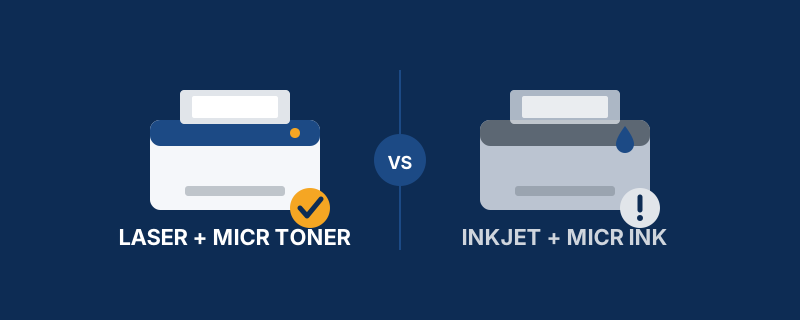
For most people, laser check paper printed with MICR toner is the safer buy. The magnetic particles banks read at the bottom of a check embed cleanly in solid toner, while magnetic inkjet ink is harder to formulate consistently — suppliers note that magnetic particles tend to settle in liquid ink, and ink absorption varies from paper to paper, which can weaken the magnetic signal. Inkjet check printing is possible with a dedicated MICR ink cartridge and inkjet-rated check stock, but it is the exception, not the default.
Does Check Paper Differ by Printer Type?
Yes — and the difference is in the surface, not the security features. Laser printers fuse toner onto the sheet with heat, so laser check stock is made to take that heat without curling or offsetting. Inkjet printers spray liquid ink, so inkjet-rated stock is finished to absorb ink without feathering or bleeding. Many blank check papers are sold as compatible with both, but the listing should say so explicitly. If a sheet is rated for one process only, running it through the other is where you get smudged amounts and a MICR line the bank's scanner struggles to read.
Whichever you choose, the security features that make check stock check stock — microprinting, watermarks, chemical-reactive coatings — are properties of the paper itself, not of the printer. Our guide to check paper security features breaks down what each one defends against, and our guide to MICR check paper covers the magnetic line banks read.
MICR Toner vs. MICR Ink
The bigger decision is what you print with. The routing and account numbers along the bottom of a check are printed in magnetic ink character recognition (MICR) characters, and bank scanners read them magnetically. Both MICR toner (for laser printers) and MICR ink (for inkjet printers) contain iron oxide to produce that magnetic signal.
The practical difference is reliability. Toner is a solid powder, so magnetic particles can be embedded in it without separating. In liquid ink, industry suppliers point out that magnetic particles tend to settle, and that magnetic inkjet cartridges — while they do exist — are generally not recommended, because ink absorption varies so widely between papers that a consistent magnetic signal is hard to guarantee. Specialty MICR inkjet cartridges are marketed for bank-compliant check printing, but they are a niche product rather than the standard path.
This matters because of who has the final say. There is no U.S. law forcing you to use magnetic ink, but banks have the right to refuse checks that aren't printed with it — so a check that a scanner can't read is a check that may come back to you. For the wider legal picture, see is it legal to print your own checks at home.
Side-by-Side Comparison
| Laser + MICR toner | Inkjet + MICR ink | |
|---|---|---|
| Magnetic signal | Consistent — iron oxide is embedded in solid toner. | Harder to keep consistent; varies with how the paper absorbs ink. |
| Supply availability | Widely sold for many laser models. | Limited — a handful of specialty MICR cartridges. |
| Durability of the print | Fused into the paper; resists smudging and water. | Liquid ink; easier to smudge or alter. |
| Speed | Higher — workgroup MICR lasers are commonly rated in the 26–62 ppm range. | Lower — MICR-capable inkjets are typically under about 20 ppm. |
| Best for | Businesses and anyone printing checks regularly. | Low-volume personal printing on a printer you already own. |
Note: speed figures reflect vendor guidance current at the time of writing and vary by model — confirm the specs of any printer and cartridge before buying.
Which Should You Buy?
- Buying a printer anyway? Get a monochrome laser with confirmed MICR toner support and buy laser-rated blank check stock. It's the path with the fewest failure modes. Our roundup of the best printers for printing checks covers what to look for.
- Already own an inkjet and print a few checks a month? Check whether a MICR ink cartridge exists for your exact model, buy check stock rated for inkjet, and test a sheet with your bank before you rely on it.
- Printing checks for a business? Laser, without much debate — volume, durability, and scanner reliability all point the same way.
- Still deciding between blank stock and pre-printed checks? Start with our blank check stock vs. pre-printed checks comparison, then come back to the printer question.
Once you know which you need, our guide to the best places to buy check paper online compares the suppliers that stock both laser and inkjet check paper.
Frequently Asked Questions
Can I print checks on an inkjet printer?
Yes, but with conditions. You need a MICR ink cartridge available for your printer model and check stock rated for inkjet. Standard inkjet ink is not magnetic, and banks may refuse checks whose MICR line can't be read magnetically.
Is laser check paper different from inkjet check paper?
The surface finish differs: laser stock is made to withstand the heat that fuses toner, while inkjet stock is finished to absorb liquid ink without feathering. Plenty of blank check paper is sold as compatible with both — look for that stated on the listing rather than assuming it.
Do banks legally require magnetic ink?
No U.S. law requires it, but banks have the right to refuse checks not printed with magnetic ink or toner. In practice that makes MICR a requirement for anything you need reliably processed.
Can I use regular toner instead of MICR toner?
Standard toner isn't magnetic, so the MICR line won't produce the signal a bank's scanner reads. Checks may still clear if handled manually, but you're relying on an exception rather than the normal process.