Check Paper Security Features: How to Spot Fraud-Resistant Stock
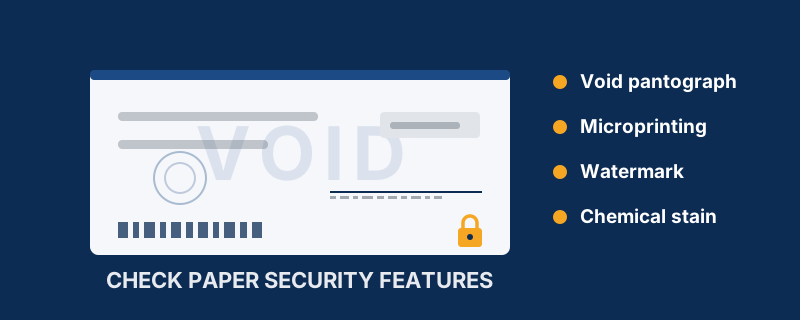
The check paper security features worth paying for fall into two jobs: stopping a check from being copied, and stopping one from being altered. Copy deterrents include the void pantograph (the word VOID appears on a photocopy), microprinting, and watermarks. Alteration deterrents include chemical-sensitive paper that stains when someone tries to wash the ink off, plus toner-grip coatings. A padlock icon on the check tells a bank teller the stock carries at least three of these. When you buy blank check stock online, look for that combination stated explicitly on the listing — not just the phrase “high security.”
Why Check Paper Security Still Matters
Checks did not stop being a fraud target when digital payments arrived — if anything, the opposite. In February 2023 the Financial Crimes Enforcement Network (FinCEN) issued a nationwide alert on a surge in check fraud tied to mail theft. In its follow-up analysis of the six months from February to August 2023, FinCEN counted 15,417 Bank Secrecy Act reports from financial institutions describing more than $688 million in suspicious activity connected to mail theft-related check fraud. In that data, 44% of the stolen checks reported had been altered and deposited rather than simply forged outright.
That word — altered — is the whole reason paper-level security exists. A thief who pulls a check out of a mailbox rarely needs to counterfeit anything. They need to remove the payee name and the amount and write new ones. The features below are the paper's answer to that, and they are properties of the stock you buy, not of your printer or your accounting software.
Features That Stop Copying
These features are designed to fail loudly when a check goes through a photocopier or scanner, so a reproduction doesn't pass as an original.
- Void pantograph. A background pattern that is nearly invisible on the original but resolves into the word “VOID” when the check is photocopied or scanned. It is the single most recognisable copy deterrent on modern check stock.
- Microprinting. Text printed too small to read with the naked eye — the Check Payment Systems Association defines it as smaller than 0.010 inches — typically hidden in the signature line or the border. Under magnification it reads as words; on a photocopy it collapses into a solid or blurred line.
- Watermarks. A translucent image visible when the sheet is tilted or held to the light. True paper watermarks are formed in the sheet during manufacture and cannot be reproduced by a copier or scanner; some check stock instead carries an artificial watermark printed onto the sheet, which is cheaper but less robust. The listing should say which one you're getting.
- Security screens. Reversed text on the back of the check — often reading “original document” or similar — designed to distort under a copier.
- Visible security fibers. Fibers embedded in the stock that show up under a black light. If a bank checks and the fibers aren't there, the document is suspect.
Features That Stop Alteration
Copy deterrents don't help against check washing, where the check itself is genuine and only the ink is attacked. These features do:
- Chemical sensitivity. The paper is treated so that solvents — acetone, bleach, brake fluid, the household chemicals used to wash checks — trigger visible staining or discoloration. The check still exists, but it now announces that someone tampered with it. This is the feature that speaks most directly to the FinCEN alteration data above.
- Toner adhesion / toner-grip coating. A surface treatment that bonds fused toner to the sheet so it can't be lifted off cleanly with tape or a blade. It only works with laser printing — see our comparison of laser vs. inkjet check paper for why toner behaves so differently from liquid ink here.
- Thermochromic (heat-sensitive) ink. An icon printed in ink that fades when you warm it with a fingertip and returns as it cools. Ordinary printers and copiers cannot reproduce the effect, so it gives a teller a check anyone can perform in a second without equipment.
- Coin-reactive ink. A patch on the back that changes colour when rubbed with the edge of a coin — another equipment-free authenticity test.
- Security warning band. A printed border or stripe listing the security features the check carries. It doesn't stop fraud by itself; it tells the person handling the check what to look for, which is what makes the rest of the features useful.
The Padlock Icon: What It Actually Certifies
The small padlock symbol you see printed on the front and back of many checks is the Enhanced Check Security Features Padlock Icon, administered by the Check Payment Systems Association (CPSA). It is not decoration: to display it, a check must carry a minimum of three security features that together defend against both counterfeiting and alteration, and those features must be overt — visually detectable by a person handling the check. Covert features that need a machine to verify do not count toward the three.
CPSA's guidance points to ASC X9/TG-8 (Check Security Guideline) and ANSI X9.100-170 (Check Fraud Deterrent Icon) as the underlying standards, and it suggests three low-cost ways to qualify: microprinted data on the signature line or border, a copier-resistant security screen with reversed text on the back, and the account number printed beneath the fractional routing symbol.
Practically, the padlock is a shortcut for the buyer. Stock that carries it has cleared a defined bar. Stock marketed as “high security” with no padlock and no feature list has cleared nothing in particular.
Feature Comparison Table
| Feature | Defends against | How it's verified |
|---|---|---|
| Void pantograph | Photocopying / scanning | “VOID” appears on the copy |
| Microprinting | Counterfeiting | Magnifier; blurs to a line when copied |
| True watermark | Counterfeiting | Hold to light / tilt the sheet |
| Chemical-sensitive paper | Check washing (alteration) | Stains visibly on solvent contact |
| Toner adhesion coating | Toner lifting (alteration) | Toner tears rather than peels |
| Thermochromic ink | Counterfeiting | Warm with a fingertip; icon fades |
| Security fibers | Counterfeiting | Visible under black light |
| Padlock icon | Both (as a certification) | Signals 3+ overt features are present |
How to Read a Check Paper Listing
Suppliers commonly sell check stock in tiers — basic, medium, and high security — and the tier names are marketing, not a standard. Judge the listing by what it enumerates:
- Count the alteration defences, not just the copy defences. Plenty of cheap stock has a void pantograph and nothing else. Given that alteration is the dominant reported fraud pattern, chemical sensitivity is the feature most worth the upgrade.
- Look for the padlock. It's the only claim on the page backed by a defined, third-party bar.
- Check the watermark type. “Watermark” alone can mean a printed artificial one. A true (Fourdrinier) watermark formed in the paper is the stronger feature.
- Confirm printer compatibility separately. Security features and printer rating are two different specs. Our guide to MICR check paper covers the magnetic line the bank actually reads — a beautifully secured sheet with an unreadable MICR line still gets returned.
- Decide security level before you decide format. If you're still weighing blank stock against pre-printed, our blank check stock vs. pre-printed checks comparison covers the cost side, and our roundup of the best places to buy check paper online lists suppliers that publish full feature lists rather than a tier name.
Frequently Asked Questions
What are the most important check paper security features?
Chemical sensitivity (against check washing), a void pantograph (against photocopying), and microprinting (against counterfeiting) are the core three, and together they satisfy both halves of the problem — alteration and reproduction. A watermark and a toner adhesion coating are the next most useful additions.
What does the padlock icon on a check mean?
It is the Check Payment Systems Association's Enhanced Check Security Features Padlock Icon. A check may display it only if it carries at least three overt security features that defend against both counterfeiting and alteration, per the ANSI X9.100-170 and ASC X9/TG-8 guidelines.
Does blank check stock have security features, or only pre-printed checks?
Blank check stock is available with the full set of paper-level features — watermarks, chemical sensitivity, void pantograph, security fibers — because those are built into the sheet at manufacture. What you add at print time is the bank data and the MICR line. Basic blank stock without them also exists, which is why the listing matters.
Can security paper stop check washing completely?
No. Chemical-sensitive paper doesn't prevent someone applying a solvent; it makes the attempt visible, so the altered check can be spotted and refused. It shifts the outcome from an undetected loss to a caught attempt — which is the realistic goal of every feature on this page.
Sources
- Check Payment Systems Association — The Padlock Icon
- CPSA — Guideline for Use of the Enhanced Check Security Features Padlock Icon (PDF)
- FinCEN — In-Depth Analysis of Check Fraud Related to Mail Theft
- FinCEN — Alert on Nationwide Surge in Mail Theft-Related Check Fraud
- StockChecks — High Security Check Paper: Every Feature Explained
- Checkrun — High Security Blank Check Stock Features